NICS Microbiom Rebalance

Lactulose is a synthetic disaccharide consisting of D-galactose and fructose. When ingested orally, it reaches the large intestine in a virtually unchanged form and acts there.
Why is lactulose important?
Lactulose helps to speed up intestinal transit.
Dextrin is the collective name for compounds that are isomeric with starch and belong to the carbohydrate group, forming a kind of transition between starch and sugar. Nutriose is a soluble fibre.
Oligosaccharides are sweet-tasting compounds consisting of a few monosaccharides. Fructo-oligosaccharides are water-soluble fibres. These fibres are synthesised by the fungus species Aspergillus nigricans in the presence of sugar or sucrose.
Oligosaccharides are sweet-tasting compounds consisting of a few monosaccharides. Galacto-oligosaccharides consist of short chains of galactose molecules.
Oligosaccharides are sweet-tasting compounds consisting of a few monosaccharides. Isomalto-oglycosaccharide is a non-digestible fibre.
Gum Arabic, or Arabian gum, is a rubbery secretion of certain acacia species native to Africa. Chemically related to pectins. It is 95 % polysaccharide and the remainder a mixture of oligosaccharides and glycoproteins. It is highly soluble in water.
Oligosaccharides are sweet-tasting compounds consisting of a few monosaccharides. The xylo-oligosaccharide is a water-soluble, low molecular weight, indigestible carbohydrate.
Jerusalem artichoke is a tuberous perennial herb of the family of the herbaceous perennials. It can grow to a height of two to two and a half metres. It was introduced to Europe from North America. It is closely related to sunflowers. It has a similar taste to potatoes but is sweeter. Its gums contain mainly inulin and little starch.
None of the 9 fibres mentioned above are digestible, and after ingestion they reach the large intestine in unaltered form, where they exert their action by helping the good bacteria to multiply.
Bromelain is a naturally occurring enzyme in pineapple. Pineapples are native to Central and South America. The enzyme, like papain, can break down animal and human proteins.
Papain is the protein-degrading enzyme in papaya fruit. Papaya is a plant native to Central America, but is now found in many parts of the world.
Piperine is an organic compound that is yellowish or colourless and has a strong peppery taste. It gives pepper its characteristic taste. Its name comes from the Latin or Greek name for pepper. It can help the absorption of nutrients in the body. Black pepper is a shrub native to the tropics, known and sought after since ancient times.
Prebiotics are the natural nutrients that are typically the exclusive nutrients of probiotics and therefore promote their proliferation and predominance. In the oral cavity or gastrointestinal tract, digestive enzymes do not break down prebiotics, so they can pass undigested into the large intestine. Prebiotics are dietary fibres, but they are water soluble, making them the most excellent of all dietary fibres. In addition to their dietary fibre function, their real utility lies in the fact that they are the sole food source of probiotics. As the large intestine is already low in digestible food, i.e. relatively malnourished, ingested prebiotics offer the opportunity for the proliferation of human-friendly gut bacteria.
In their natural state, they are found in many foods, e.g. Jerusalem artichokes, chicory root, onions, garlic, leeks, artichokes, wholegrain cereals, wheat, bananas, flax, spinach, spinach, cabbage, Swiss chard, mustard, berries, pulses, milk and most mature cheeses.
One type of prebiotic is Inulin, basically a dietary fibre that enters the colon undigested, enhancing the proliferation and overgrowth of probiotics.
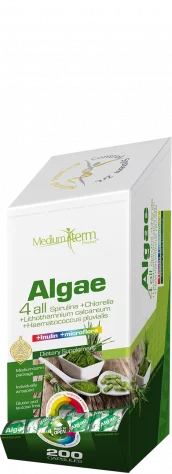
The dietary supplement shown here has been awarded the Value and Quality Grand Prize.
In total, 18 of our products have already earned this prestigious label, a guarantee of quality and that you are using the best possible supplement to maintain your health.